
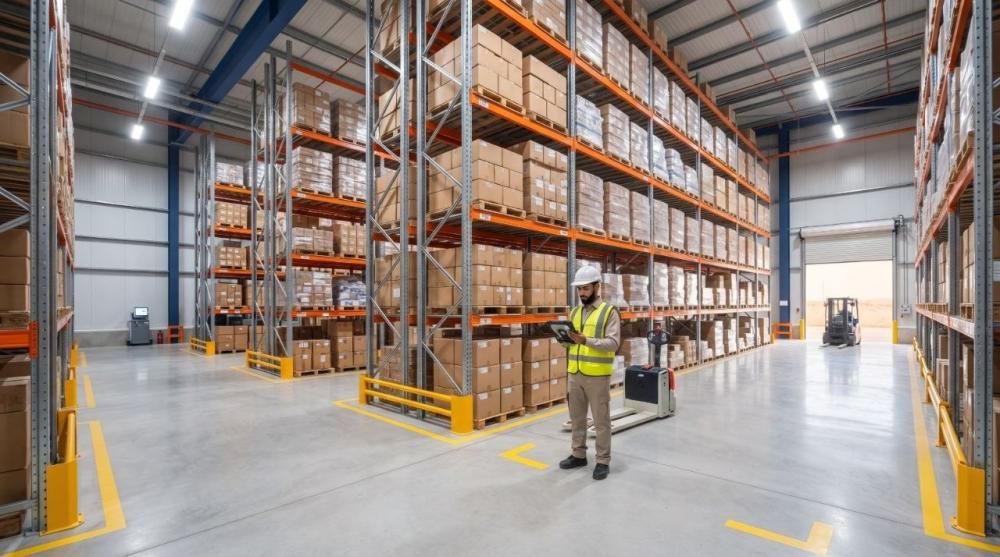
5 Common Warehouse Organization Mistakes That Cost You Time and Money
Many store and warehouse owners in Riyadh and Saudi Arabia face a recurring problem: large storage space, but poor operational efficiency. The problem is often not the size of the space, but how the warehouse is organized and the storage shelving system used. In this comprehensive guide, we explore the 5 most common mistakes made when organizing warehouses and how you can avoid them to save time, reduce operating costs, and improve workflow within the facility.
Whether you manage an industrial warehouse, distribution center, or retail store warehouse, applying proper inventory management principles through suitable storage racks can make a direct difference in daily productivity.
Why Does Good Warehouse Organization Matter?
Before getting into the mistakes, it is important to understand the direct impact of warehouse organization on operations:
- Reduce product search time (Pick Time): Every second an employee spends searching for an item is a direct operating cost.
- Reduce inventory counting errors (Inventory Accuracy): A clear system reduces lost goods and inventory errors.
- Improve workplace safety (Workplace Safety): Organized shelving and aisles reduce workplace injuries and falling accidents.
- Increase storage capacity without physical expansion: By intelligently utilizing vertical and horizontal space.
Mistake #1: Randomly Distributing Goods Without a Classification System
One of the most common mistakes is storing products wherever there is available space without following a clear system — whether by category, movement rate (Fast/Slow Moving), or arrival date (FIFO/LIFO). The direct result is wasted time searching for products, repeated inventory errors, and difficulty training new warehouse employees on the storage system.
Practical Solution:
- Adopt a fixed classification system (Categorization System) — for example, by product type, size, or turnover rate.
- Install clear signs and labels (Labeling System) on every shelf and storage unit.
- Use logical aisle and shelf numbering (Location Coding) to make it easier to track every item digitally or manually.
Mistake #2: Ignoring the "Fast-Moving Items First" Rule
Products that are frequently ordered or used should be within easy reach — on lower and middle shelves, and close to the loading or sales point, rather than in the farthest location or on the highest shelf requiring additional equipment to access.
Practical Solution:
- Identify "fast-moving" products (Fast-Moving Inventory) by analyzing sales or monthly usage data.
- Place them on storage racks closest to the loading door or packing area.
- Gradually distribute the remaining products according to demand rate in more distant areas (the ABC warehouse management principle).
Mistake #3: Failing to Utilize Vertical Space
Many warehouses in Riyadh use only their floor space, while the upper part of the ceiling remains completely empty. This is a direct waste of potential storage capacity and may result in paying for additional rental space unnecessarily or settling for less storage capacity than the facility could provide.
Practical Solution:
- Use multi-level vertical storage rack systems (Multi-Tier Racking Systems) that utilize the full height of the facility.
- Ensure safe access to upper levels through dedicated ladders or forklifts suitable for the rack height.
- Choose heavy-duty metal shelving (Heavy Duty Shelving) designed to safely support heavy loads across multiple levels.
Mistake #4: Loading Shelves Beyond Their Designed Capacity
Some warehouses load their shelving with weights exceeding the safe limit recommended by the manufacturer, assuming that "the shelf can handle more than what is stated." This is a serious mistake that can lead to shelf bending or collapse, damaged goods, and worker injuries — risks that fall under workplace safety requirements in commercial and industrial facilities.
Practical Solution:
- Always follow the load capacity chart (Load Capacity Chart) provided with each rack type when purchasing.
- Place heavier items on lower shelves and lighter items higher up to lower the center of gravity.
- Regularly inspect shelves for signs of stress or rust, especially older metal shelving.
Mistake #5: Not Leaving Enough Aisle Space for Workers and Equipment
The desire to utilize every centimeter of available space can lead some facilities to narrow their aisles, making it difficult for workers or transport carts to move around. This slows down operations, increases the likelihood of accidents, and makes periodic inventory counting much more difficult.
Practical Solution:
- Plan aisle width (Aisle Width) according to the type of equipment being used — hand carts, narrow forklifts, or standard forklifts.
- Leave an additional safety margin at aisle intersections and loading points.
- Use floor markings (Floor Markings) to clearly define movement paths.
Frequently Asked Questions About Warehouse Organization
What is the best type of shelving for a commercial warehouse in Riyadh?
The choice depends on the type and movement pattern of the goods, but heavy-duty metal shelving (Heavy Duty) is suitable for most commercial and industrial warehouses because of its durability and ability to handle heavy loads.
How much does it approximately cost to equip a warehouse with professional storage racks?
The cost varies depending on the space, rack type, and number of units required. It is recommended to request an on-site assessment to receive an accurate quotation suited to your actual needs.
Can the shelving system be modified later as the business grows?
Yes. Modular racking systems (Modular Racking Systems) are specifically designed to allow units to be added or modified without replacing the entire system, helping reduce costs over the long term.
How Can Watan Al Rfoof Help You Avoid These Mistakes?
At Watan Al Rfoof, we do not simply sell metal shelving. We help you design an integrated storage system (Complete Storage Solution) suited to your space and the type of goods you store, ensuring maximum use of available space and the highest level of workplace safety. We serve customers in Riyadh and across Saudi Arabia with customized storage rack solutions for warehouses, retail stores, and small factories.
Contact us today for a free consultation and an initial design for your warehouse storage system.